
- Deluxe Pro Goals 4″ Round With Clip Channel
- Deluxe European Aluminum Goals
- Semi Permanent 4″ Goals with Channel
- Portable Aluminum Goals
- Three-piece goals
- Futsal Soccer Goals
- Indoor-Outdoor Goals
- Sand Soccer Goals
- Stadium Style Goals
- Portable & Permanent Rugby Goals
- Training Goals
- Portable & Permanent Football Goals
One Field, Several Teams: Where Wheeled Soccer Goals Earn Their Keep

A field does not always need more space. Sometimes, it needs equipment that can adapt to the space it already has. A youth practice may need one goal setup, while a tournament crew may need another later. That is where soccer goals with wheels can earn their place, helping clubs change the field without treating large goals like fixed fixtures.
Why Do Clubs Need Goals They Can Move?
Field schedules can change several times in one day.
A soccer club may run youth drills in the morning, team training in the afternoon, and match practice in the evening. A school may also share the same field with a local club. Then, on the weekend, the space may host league games or a tournament.
Each activity can call for a different setup.
A club may need to:
- Open more space for small-sided games
- Move a goal during field work
- Set up a full-size practice area
- Clear part of the field for another program
- Change goal positions between sessions
A movable goal gives staff another option. They can set the field around the activity instead of forcing every team to work around the same goal position.
One Field Can Handle Different Training Needs
A shared field does not have to serve every team in exactly the same way.
Picture a club with four teams.
The U-10 group may spend its session on passing and finishing drills. Later, an older team may need a larger space for tactical work. The final session may need two full-size goals for a match simulation.
The field stays the same. The setup changes.
That difference matters when a club has limited field space. Instead of keeping large goals in one spot all day, staff can move them when the next activity calls for a different layout.
This approach can also help coaches make better use of smaller areas. A coach can create a training zone, move a goal aside, and then open the space again for the next group.
How Do Wheels Make Large Goals Easier To Handle?
Large goals can be awkward to move.
Staff may need to lift, carry, or drag parts of the frame. That takes time, and it can make a simple field change harder than it needs to be.
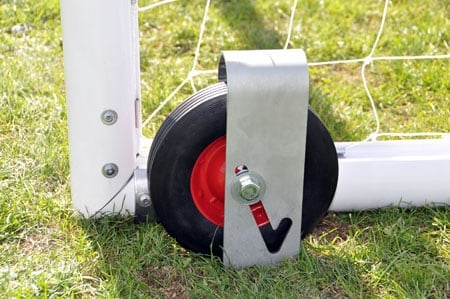
A suitable wheel system can make repositioning easier.
For example, a team finishes practice at 5 p.m., and another group needs the field at 5:15. Staff can move the goal to its planned location instead of leaving it in the way.
However, wheels do not mean someone should simply push a goal across the field without a plan.
Staff should:
- Follow the manufacturer’s moving instructions.
- Use the correct handling method.
- Keep players away from the moving area.
- Put the goal in its proper position.
- Secure it before play begins.
Wheeled Goals Fit Certain Field Setups
Wheeled goals make the most sense when staff move larger goals on a regular basis.
They can suit:
- Soccer clubs with packed training schedules
- Schools that share athletic fields
- Sports facilities with several programs
- Training centers with changing layouts
- Clubs that host tournaments and league games
Consider a school field that serves students during the day and a soccer club in the evening.
The school may need an open area for another activity. The club may need full-size goals later. On Saturday, tournament staff may need to prepare the field for several matches.
A goal that staff can reposition gives them more control over the space.
But if a field keeps the same goal position all year, wheels may offer little benefit. Clubs should look at their actual schedule before buying.
What Should Clubs Check Before Buying?
The right goal should fit the players, field, and daily routine.
Start with the goal size. Youth teams may need smaller goals, while older players may train with full-size goals.
Then consider how the goal will work on the field.
Ask:
- How often will staff move it?
- Who will handle it?
- Where will they store it?
- Does the field have enough room for safe movement?
- Does the goal come with wheels?
- Can the club add the right wheel system?
- Which net fits the frame?
- What anchoring system does it need?
Also check the goal’s intended use.
A training goal does not always suit competitive match play. Likewise, a full-size match goal may not make sense for every youth training area.
Safe Anchoring Still Matters After Goal Movement
A goal that moves easily still needs to stay secure during play.
That makes soccer goal anchors an important part of the setup. Clubs should use the correct anchoring system for the goal and follow the manufacturer’s instructions.
Staff should also check the setup regularly.
Look at the frame, wheels, net attachments, fasteners, and anchors. If something looks loose or damaged, staff should fix the issue before players use the goal.
This matters even more when several teams use the same equipment each week.
A quick equipment check can catch small problems before they disrupt training or create a safety concern.
How Can Clubs Manage Storage After Moving The Goals?
Moving the goal solves only half the problem.
The club also needs somewhere to put it.
A storage area should keep the goal away from player traffic and other equipment. Staff should have enough room to move the goal in and out without hitting walls, fences, vehicles, or stored gear.
This becomes important when a club owns several goals.
For example, staff may move two full-size goals after a weekend match. If the storage area cannot handle both frames, the field may end up with equipment sitting in walkways or along the sidelines.
So, before buying, measure the storage space as well as the playing area.
A goal may fit the field perfectly but still create headaches after practice if nobody has planned where it will go.
When Is A Permanent Goal The Better Choice?
Wheels are useful, but they do not automatically make a goal the right choice.
A permanent goal can work better on a dedicated competition field. If staff rarely change the layout, there may be little reason to move the goals.
Portable goals can suit training areas that change often. Semi-permanent goals can offer a middle ground for fields that need regular use but still require some flexibility.
| Goal Setup | Best Fit |
| Portable | Training areas that change often |
| Wheeled | Larger goals that staff reposition regularly |
| Semi-Permanent | Regular-use fields that need some flexibility |
| Permanent | Dedicated fields with a fixed layout |
Common Buying Mistakes Can Create Extra Work
The biggest mistake is buying based only on the goal itself.
A club should think about the complete setup.
That includes the frame, net, anchors, wheels, storage space, and replacement parts. If one part does not fit the club’s routine, staff may end up doing more work than expected.
Another mistake is assuming every team needs the same goal.
A youth program, goalkeeper session, and competitive team may all have different needs.
Finally, do not overlook the people who handle the equipment. If field staff move the goal several times each week, the movement process should be practical and clear.
The goal should make their job easier, not turn every field change into a chore.
How Can Clubs Get More From The Field They Already Have?
Clubs cannot always add another field.
They can, however, make better use of the space they already control.
Wheeled goals can give staff more options when they need to change goal positions between practices, training groups, maintenance work, and matches.
That flexibility can be especially useful when several teams depend on the same field.
Still, wheels are not a magic fix. The club needs the right goal size, safe anchoring, suitable storage, and a clear plan for moving the equipment.
When those pieces work together, a single field can handle a much wider range of activities.
Wrap Up
A shared field does not have to stay locked into one goal setup. The soccer goals with wheels can give clubs the freedom to reposition larger goals when different teams, training sessions, and match plans call for a change.
Fold – A – Goal has more than 40 years of experience serving clubs, schools, coaches, and families with soccer equipment. Its range includes portable and semi-permanent goals, nets, anchors, wheels, field equipment, and replacement parts. For clubs that need practical equipment for changing field layouts, weoffer solutions built around real field use.
Frequently Asked Questions
1. Can Wheeled Soccer Goals Be Used For Competitive Matches?
Yes, suitable wheeled goals can support competitive play when they meet required size, stability, anchoring, and safety standards.
2. Do Soccer Goals With Wheels Need To Be Anchored?
Yes, wheels do not replace anchors. Clubs should secure goals properly before players use them during training or matches.
3. Are Wheeled Goals Useful For School Soccer Fields?
Yes, they help schools adjust field layouts when different sports, classes, teams, or activities share the same playing area.
4. How Often Should Clubs Check Wheeled Soccer Goals?
Clubs should inspect frames, wheels, nets, fasteners, and anchors regularly, especially when several teams use the goals each week.
5. Are Wheeled Goals Better Than Permanent Soccer Goals?
Not always. Wheeled goals suit changing field layouts, while permanent goals work well when the playing setup rarely changes.